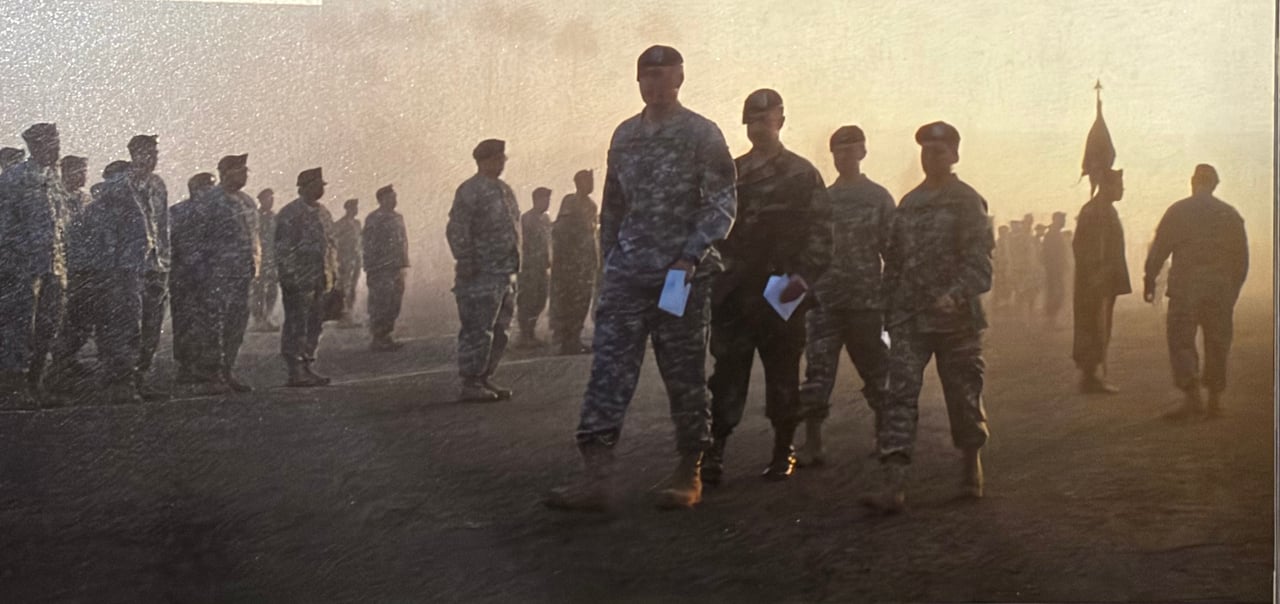
Every Veterans Day, I find myself thinking about the people in my family who answered our nation’s call to serve—and about the cost that service can carry.
My father served in the United States Marine Corps as a helicopter pilot. My maternal grandfather served aboard the USS San Francisco during World War II. Many other members of my extended family have worn the uniform. Their service is part of our family story, passed down through the generations with gratitude and respect.
My own path led me to Texas A&M University, The Corps of Cadets and to the United States Army. I remember taking the oath of office as an Army officer alongside friends who had made the same commitment. We were young and ready to serve. In the years that followed, some of those friends were severely wounded. Some paid the ultimate price. I carry their memory with me.
War’s cost reaches far beyond the battlefield
War is awful. The word can sound distant until it has a face: a friend who does not come home, a family waiting for news, a veteran carrying an injury or memory that others cannot see. The people who serve bear the immediate danger, but their families bear long separations, uncertainty, fear, and grief. The effects can follow everyone home.
Remembering that cost does not diminish the courage of those who served. It helps us understand the weight of what they accepted and what their families endured. We can honor veterans without romanticizing war. We can be grateful for courage while praying that fewer people will ever be asked to show it under fire.
There is a familiar saying often attributed to Edmund Burke: "The only thing necessary for the triumph of evil is for good men to do nothing" A closely related, documented passage appears in John Stuart Mill’s 1867 address at the University of St. Andrews: “Bad men need nothing more to compass their ends, than that good men should look on and do nothing.” The idea has stayed with me because it speaks to the responsibility that comes with freedom: when people face injustice or danger, turning away is not enough.
That responsibility is not a celebration of war. It is a call to protect others, to defend what is right, and to work toward a peace in which no one has to fight. Jesus gave words to the depth of sacrificial love: “Greater love hath no man than this, that a man lay down his life for his friends” (John 15:13, KJV). Military service can ask for that kind of courage, but service also lives in the care veterans give their families and communities long after they leave uniform.
Gratitude asks something of us
Veterans Day honors all who have served in the Armed Forces, in wartime and in peace. It is a day to say thank you, to listen to veterans’ stories when they choose to share them, and to remember that every person’s experience is different. Some carry visible wounds; others carry burdens they rarely discuss. Many families served alongside them in ways that went unseen.
At Stearns Ranch Realty Group, we often think about stewardship: caring responsibly for what has been entrusted to us and considering what we will pass on to the next generation. Veterans Day brings that idea into focus in a different way. The freedoms and communities we inherit were protected and sustained by people who accepted responsibility, served their neighbors, and sometimes gave more than we can fully measure.
To the veterans in my family, to the friends who served beside me, and to all who have worn the uniform: thank you. To the families who waited, encouraged, worried, and carried on: thank you. To those who did not come home, and to those who still live with the cost of service, we remember you with gratitude and humility.
May our thanks be more than words. May we stand up when others need help, care for those who have served, and do our part to preserve peace. That is one way we can honor the people who answered the call.